

View Press Release

- A Monster Year for Game Consoles
- Wal-Mart Opens Doors on Revolution, PS3 Sites
- 3000 AD announces two new Xbox 360 titles
- Xtreme Enterprise Reveals Xbox 360 Faceplates
- Analyst: 360 to maintain lead, PSP to pull ahead
- Clover Studios Interested in Nintendo Revolution
- New Nintendo Revolution Game? | NintendoRevolution...
- Xbox 360 Feb' Preview Announced
- Comment: Sony's Real War Begins
- RR Contest: Nintendo Revolution Dream Game Concept
- PlayStaion 3
- Revolution
- Xbox 360
- ImageShack
- BDGamer
- ButtonMashing.com
- Gamer Andy
- GamerTag Pics
- Game Scooped
- Gaming-360
- Major Nelson
- Nintendo-Centrum
- Nintendo-Next
- N-Retro
- OnlyXbox
- Planet Xbox 360
- Pro-G
- PS3Blog.net
- PS3 Forumz
- PS3 Power
- PS3
- SpotonGaming
- The Console Conspiracy
- TheODL.com
- Total NextGen
- Xbox 360 News


What has Microsoft learned from the Xbox launch?
 "Looks like Dean Takahashi, author of Opening the Xbox: Inside Microsoft’s Plan to Unleash an Entertainment Revolution, is planning another book. This time it’s on the 360 and he wants to know what lessons Microsoft has learned from the launch of the first Xbox in November, 2001.
He’s written up some well-known blunders like:
* The box and the controller were too big for the Japanese market. (Did they solve this with the “inhale” design and new controller?)
* The machine launched with too few games geared to Japanese tastes. (Is Japan starting to warm up to the idea of a new Xbox?)
Then again, there are some things that raise doubts:
* The hard drive wasn’t as much of an asset as Microsoft hoped. (With developers being unable to rely on the hard drive in the 360, will it exist solely to store content on, like music, Arcade titles, maybe even games!)
* Microsoft launched too late. Sony sold more than 20 million units by the time Microsoft sold its first 1.5 million. (Will launching earlier help them? It certainly didn’t help another little white box that ran on Windows.)
What do you guys think Microsoft has learned from, all things considered, the otherwise successful launch of their first game system?" [link]
Related Link: Dean's New Xbox 360 Book: What Are The Lessons For The Second Time Around?

D.Vader // 11/12/2005 08:35:00 PM //
PermaLink
//


Blu-ray is about set to become Hollywood's preferred standard

Although Microsoft is backing HD DVD and will offer native support for this format in its upcoming operating system, the entertainment industry is likely to have the most impact on which side succeeds in become the successor. For example, as Sony's upcoming PlayStation 3 will incorporate Blu-ray support as well as the playback of Blu-ray movies, the success of Sony's PlayStation 1 & 2 series may be enough to push sufficient PlayStation 3's on the market to ensure Blu-ray succeeds, since anyone with a PS3 will in turn effectively have a standalone player to play Blu-ray movies." [more]

D.Vader // 11/12/2005 03:08:00 PM //
PermaLink
//
MGM joins Blu-ray camp

MGM has joined Sony, Walt Disney and Twentieth Century Fox in committing to releasing only in the Blu-ray format.
Warner Brothers and Paramount Pictures have said they will release films and other content in both formats, while Universal Studios will support the HD DVD format exclusively.
'Adopting this new Blu-ray technology with its expanded storage capacity and increased interactive capabilities allows us to continue to provide our customers with the best movie viewing experience available,' said Harry Sloan, chairman and chief executive at MGM Studios.
But all is not lost for HD DVD. Microsoft and Intel are still supporting the standard, as are a number of PC manufacturers.
One possible outcome is for one standard to dominate in corporate computing while the other is used exclusively for consumer entertainment." [link]

D.Vader // 11/12/2005 03:06:00 PM //
PermaLink
//
360 to play 200+ Xbox games

After playing coy for months about the Xbox 360's backwards compatibility, Microsoft has finally come clean. The software behemoth announced late Friday that over 200 games from its current-generation console will play on its next-generation console.
As one might expect, Microsoft has made sure all the top Xbox games are supported, including Halo and Halo 2, Star Wars: Knights of the Old Republic I and II, Ninja Gaiden and Ninja Gaiden Black, and the three Grand Theft Autos: III, Vice City and San Andreas. A total of 212 Xbox games will be playable on the 360 at launch, though Microsoft says that number will increase.
Friday also brought good news to Xbox Live addicts. Any of the backwards-compatible games will be playable cross-platform between the Xbox 360 and Xbox over Xbox Live. That means would-be Master Chiefs with a 360 can still own their friends playing on current-generation consoles--although the former will see the carnage in higher resolution.
However, there is a catch. To play an Xbox game on the 360, players must first insert the current-gen game into a next-gen console hooked up to Xbox Live. The system will check if the console has the latest emulation software. If not, it will automatically download said software, install it on the 360, restart, and load the original Xbox game. Obviously, a 360 hard drive--which comes with the Halo and Halo 2 software preinstalled--is required the backwards-compatibility software." [more]

D.Vader // 11/12/2005 03:04:00 PM //
PermaLink
//
PlayStation 3 controller gets no love; redesign imminent?

Pictured above, the latest comical take on the controller, in the style of one of those demotivational posters that have been popular for years now." [link]

D.Vader // 11/12/2005 01:11:00 PM //
PermaLink
//
Xbox 360 Excitement Approaches Fever Pitch
 "With just 11 days until the North American launch of the next generation of Microsoft's gaming console, Xbox 360 fever has fully descended upon us, including everything from golden tickets in Hershey bars to swank lounges, tribal gathering-like launch parties, and nagging worries over shortages.
Burning Xbox?
According to an online post, "The Xbox 360 Launch event will take place at an as yet-unnamed location in the middle of the desert in CA. There will be thousands of gamers there from around the world, celebrating the launch of Xbox 360. There will be copious Xbox 360 systems set up with high-def monitors, surround sound, the works … Microsoft is calling it 'Burning Man Meets E3.'"
(Green and) Golden Tickets
Leaked camera phone pictures of Wal-Mart stores readying their outlets for the launch madhouse at midnight on No. 22 show instructions about taking tight inventory, the Xbox 360 Experience Disk, and the "golden" launch tickets.
"Employees have been instructed to distribute numbered tickets (as many as the store has of 360 units) starting at 10:00 PM on the 21st. The tickets are divided into two sets (green and silver), in order to differentiate between the core and premium bundles. Rumor has it, a few tickets will be hidden in select Hershey bar wrappers."" [more]

D.Vader // 11/12/2005 01:09:00 PM //
PermaLink
//
REVOLUTION CONTROLLER: YOURS, NOW, FREE!
 "Mis-leading headlines ahoy as Nintendo Japan gives something back to the fans with its Revolution TV remote
It's the must-have gaming accessory of 2006 and you can get one right now. If you live in Japan. Sort of. Of course we're talking about the fabled Nintendo Revolution controller, a artifact of near-mystical proportions, specifically designed to build and tone those flabby bingo wings while enhancing your gameplay experience via the power of tossing yourself around the living room like a spasmodic buffoon.
Now, those wiley folks at Nintendo have announced a special promotion enabling dedicated Japanese gamers to get their mucky fingers on the controller early - or at least that's what they'll be telling their friends when the slinky white fella slips through the letter box. What they're actually getting is a specially designed television remote, fashioned to look exactly like Nintendo's next-gen fun stick.
The cheeky facsimile will be awarded to members of the points-based Club Nintendo programme. If you've managed to amass a total of 400 points by purchasing a veritable cascade of Nintendo games - thus rocketting you up to Premium Member status - then your remote's in the bag. You'll also get a fetching Nintendo calander thrown in too, but that's marginally less exciting. Of course all this is utterly irrelevant if you don't live in Japan.
We did the rounds this morning to check whether we can expect to see the sexy freebie being made available to members of Nintendo's European VIP scheme but it's not looking good at the moment. Which isn't to say they'll never put in an appearance over here. After all, we're sure you'll be able to pick one up on eBay shortly for roughly the retail value of a small tropical island." [link]

D.Vader // 11/11/2005 05:14:00 PM //
PermaLink
//
Best Buy Files: The Official 360 Document

I’ll be delivering details from it through-out the day. Expect to see the following:
A full listing of stores that will be open until midnight
The official launch titles
Best Buy’s prediction for top selling games
Sales estimates and total units shipped
Accessory supplies and prices
How the big day itself will be handled
The 360 Best Buy Maze of getting the hell out without buying needless shit
This is gonna be fun." [link]

D.Vader // 11/11/2005 05:13:00 PM //
PermaLink
//
First images of Splinter Cell 4


The screenshots were taken from a recent Splinter Cell 4 trailer. The quality of the shots aren't the greatest, but they definitely give you that feeling that the series is heading in a new and exciting direction. For starters, Sam Fisher looks to be breaking out of prison..." [more]

D.Vader // 11/11/2005 12:15:00 PM //
PermaLink
//
Is the XWand the Revolutionary Xbox 360 Controller?
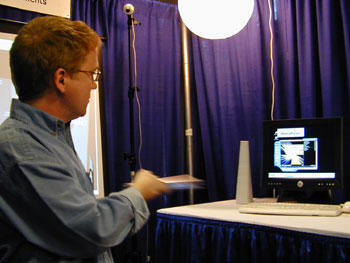
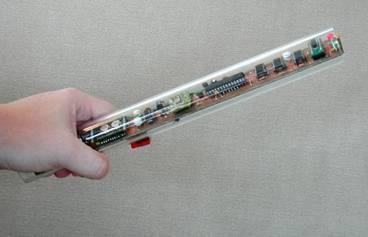
Is the XWand the Revolutionary Xbox 360 Controller?
By: Richard Allen
Here is a quote from the Microsoft Research site that explains the technology:
"The XWand is a novel wireless sensor package that enables styles of natural interaction with intelligent environments. For example, a user may point the wand at a device and control it using simple gestures. The XWand system leverages the intelligence of the ubiquitous computing environment to best determine the user's intention.
Work on the XWand can be divided into two broad categories: the design of the hardware device, and the design of the user experience and software system that uses the hardware device. Prototypes of both halves of the system have been developed.
Hardware device
The XWand hardware device includes a custom printed circuit board (PCB) with a variety of off-the-shelf sensors, including a 3-axis magnetometer, a 2-axis MEMS accelerometer, and a 1-axis piezoelectric gyroscope. The output of these sensors is collected and formatted by an onboard PIC microcontroller and passed to a 418MHz FM transceiver. A base station (not shown) receives data packets from the wand at about 50Hz, and passes the sensor readings to the host PC via RS-232. The wand also has 2 visible LEDs for feedback, a pushbutton for user input, and two IR LEDs for position tracking.
The magnetometer and accelerometer readings may be combined on the host side to obtain the true 3d orientation of the wand with respect to the room.
The IR LEDs support 3d tracking via external cameras. The PIC is programmed to flash the IR LEDs at a predefined rate, such that simple image processing software on the host PC can recover the 2d position of the wand in each camera view. This 2d information from multiple cameras is combined to find the 3d position of the IR LEDs.
The RF part on the wand may send as well as receive data. Presently the wand uses a call/response protocol, in which the host PC sends a request for data, and the wand sends a data packet back. The bi-directional aspect allows for sending commands from the host to the wand to, for example, turn the on-board LEDs on and off, and it allows for multiple wands to share the same frequency."
Now it remains to be seen if they impliment this kind of technology with gaming, but it is interesting to see that each of the 3 contenders have some ideads that are nearly identical. Call it the creative community consciousness.
Link: XWand: UI for Intelligent Environments

D.Vader // 11/11/2005 10:07:00 AM //
PermaLink
//
PS3 tops UK poll as most anticipated next-gen console
"Survey gives Sony's console 5 per cent lead over Xbox 360
 With just weeks to go until the Xbox 360 hits European shelves, a survey has revealed that UK gamers are most looking forward to the arrival of the PlayStation 3.
The survey, which was conducted by research firm XTN Data in September, found that of the 1000 respondents questioned, 32 per cent were planning to buy a PS3, while 27 per cent said they would purchase an Xbox 360. The survey did not ask respondents for their opinion on Nintendo's Revolution console.
"This comes despite huge efforts by Microsoft to launch in time for the vital Christmas period and before Sony's 2006 launch," said XTN Data founder Greig Harper. The Xbox 360 is due to launch in Europe on December 2.
The survey also found that 11 per cent of those questioned use filesharing software to download games illegally. The most downloaded titles are Rome: Total War and The Sims 2, with Grand Theft Auto: San Andreas topping the bill - it's downloaded an average of 75 times per hour." [link]

D.Vader // 11/11/2005 09:49:00 AM //
PermaLink
//
Microsoft declines to comment on UK Xbox 360 shipments

Microsoft declines to comment on UK Xbox 360 shipments
"UK Xbox boss Neil Thompson has said that the Xbox 360 will be hard to get hold of this Christmas.
"Xbox 360 is the hottest gift this Christmas and will be hard to find - but we're working hard to ensure there's a regular replenishment of stock to retail," said Thompson.
The rumour of only 50,000 units for the UK launch comes from the Official Xbox Magazine website which claims the source of the information is a representative form a leading UK videogame retailer. The source also says that pre-ordering may not help you get a console at launch.
"We started taking pre-orders for Xbox 360 back at the start of summer, and by the end of June one store already had 300," said the unnamed source. "Customers can still put their names down for an Xbox 360, but we can't guarantee that they'll get their system before Christmas."
Thompson declined to comment on the rumour and stated: "Microsoft does not have an official Xbox 360 presale program and we are unable to verify the status of these retailer programs."" [link]

D.Vader // 11/11/2005 09:29:00 AM //
PermaLink
//
Xbox 360 Zero Hour – Your Chance to Be There!

On Sunday, November 20th, shortly after the sun goes down, Microsoft’s Xbox 360 Zero Hour Event will be heating up, and won’t cool down until 12:01 am on November 22nd – the official launch date of the Xbox 360 in North America.
A top secret location in the middle of the Mojave Desert will be the mecca of the next-generation of video gaming for one night, and one night only. We told you this past Monday that TeamXbox.com would give you (and a close, personal friend) a chance to attend the Zero Hour event, and the time has finally come!
By clicking on the URL below, you’ll be directed to a sign up page in which we’ll ask for some info about yourself. Just fill out the info, hit send, and that’s all there’s to it. You’ll be entered in the drawing for a pair of tickets to Zero Hour.
There are only 100 tickets available to TeamXbox.com readers which will be distributed on a first come, first serve and random drawing basis, so you don’t want to wait another second!" [more]
Looks more like an Xbox 360 rave!

D.Vader // 11/11/2005 09:03:00 AM //
PermaLink
//
Xbox 360 game Kameo a best-seller at EB Games
"The Xbox 360 may not be on store shelves yet, but it may have its first best-selling title.
 Kameo: Elements of Power, a launch title released earlier this week to retail stores, has made the EBGames.com best seller list.
The game, which features a shape-shifting female character, was developed by Rare, who is also responsible for the anticipated Perfect Dark Zero.
Microsoft announced Tuesday that retailers have begun selling Xbox 360 games, accessories, and Xbox Live offerings in advance of the console's launch on Nov. 22.
Online stores have sold out of Xbox 360 launch systems and retailers expect a shortage this holiday season for the in-demand item.
Microsoft will host a two-day Xbox 360 launch event in the middle of the Mojave Desert on Nov. 20 where attendees can try out new Xbox 360 software and purchase systems from event sponsor Best Buy." [link]

D.Vader // 11/11/2005 09:01:00 AM //
PermaLink
//
Nintendo drops hints about Revolution pricing, DS restyling
"Revolution may lowball competitors to help attract consumer eyes.
 While the Xbox 360 is going to be dominating the media spotlight for the next few weeks (and possibly months), senior officials at Nintendo are quietly planting the seeds of Revolution.
Nintendo's next generation video game machine won't be out until 2006, but Reggie Fils-Aime, executive vice president of sales and marketing for Nintendo of America hinted this week the company might have a surprise up its sleeve.
Microsoft's Xbox 360 has adopted a two-tier price strategy ($299 for a bare bones version and $399 for a souped-up machine). Sony, meanwhile, has shouted from the rooftops the PS3 would be a pricey piece of equipment. Nintendo, though, seems ready to lowball its competitors on the retail front.
"Value has been a key card for us this generation and we'll continue to play it," Fils-Aime told me. "Do I expect us to be at a lower price point than our competition? Yes I do. Have we determined a price yet? No we haven't."
Nintendo employed this strategy at the beginning of this round of the console wars in 2001. While Sony and Microsoft released their video game machines at $299, the GameCube initially sold for $100 lower. Ultimately, the move didn't work as well as hoped. The GameCube is third in hardware sales, behind PlayStation 2 and Xbox, a position typically blamed on a weaker portfolio of third-party games and (initially, at least) the machine's boxy design, which even senior officials acknowledge looks childlike.
"I think there were some lessons we learned with the GameCube that we need to apply to the Revolution," said Fils-Aime. "First, we've got make sure that the titles in the first six months are strong and can drive sales. We've also got to make sure the console is attractive visually. And we've got to deliver on the right consumer needs. With GameCube, at the time, portability was thought to be a big factor – that's why it has a handle. Obviously, that wasn't the case."
The Revolution (which will likely to be called something else when it hits store shelves) is aimed at a wider audience than the GameCube or any of Nintendo's previous systems. While it will play DVD movies (a departure for the company), its primary focus will be games. The Xbox 360 and PlayStation 3 will focus strongly on games as well, of course, but have their eyes on a bigger prize – digital domination of the living room. Nintendo has said it wants, instead, to attract people who do not consider themselves gamers." [more]

D.Vader // 11/11/2005 08:58:00 AM //
PermaLink
//
Canada gears up for 360 launch

Gamers can also witness the arrival of Xbox 360 to Canada at the exclusive Xbox 360 launch party, presented by MuchMusic. Fans of Xbox are invited to come to The Guvernment on Monday, November 21 for 360 minutes of entertainment featuring a live musical performance by OK Go, a special appearance by Perfect Dark Zero’s Joanna Dark, and the chance to play Xbox 360 games.
The first 360 people to arrive at The Guvernment, located at 132 Queen’s Quay East, Toronto, ON, are guaranteed entrance to the launch party. In addition, gamers attending the launch party will have exclusive access to the on-site Future Shop store and will have a chance to purchase their new Xbox 360 while at the event. The on-site Future Shop will feature Xbox 360 consoles, games, and accessories.
Midnight Madness retail events are scheduled nationwide at:
Vancouver, BC
Future Shop: 2929 Barnet Highway, Coquitlam, BC
Best Buy 2220 Cambie Street, Vancouver, BC
Edmonton, AB
Future Shop: 3451 Calgary Trail South, Edmonton, AB
Toronto, ON
EB Games: Yorkdale: 3401 Dufferin Street, Toronto, ON
Best Buy: 6075 Mavis Road, Mississauga, ON
Montreal, QC
Toys R Us: 7200 Boul. Louis-H-Lafountaine, Anjous, QC" [link]

D.Vader // 11/11/2005 07:04:00 AM //
PermaLink
//
Halo would look better on Xbox 360

Bungie has confirmed that these rumors are correct and Xbox 360 would feature backward compatibility and graphical enhancements for the first two games in its award winning Halo franchise. There are also reports that not all the current generation games for Xbox would end up working nicely on the Xbox 360 gaming console due to be launched later this month on November 22.
Bungie is celebrating the first anniversary of their Halo 2 game for the Xbox and they have specifically mentioned on their website that both the original Halo and Halo 2 will be compatible with the new console, including Xbox Live play for Halo 2. And these games would be able to take advantage of the new machine’s capabilities and will feature widescreen support, 720p (progressive-scan) support, and full-scene anti-aliasing to smooth over any jagged edges.
Bungie said in a statement: “We didn’t redo any of the old textures or geometry - this is simply the game you already own, running at a higher resolution. The results are not miraculous, but for owners of HDTVs (or VGA monitors with the appropriate cable) they are sweet.” They also have a section on their website showing the graphical differences between the two consoles when playing the same game on them." [link]

D.Vader // 11/11/2005 04:21:00 AM //
PermaLink
//
Revolution could launch outside Japan first
"Jim Merrick on Revolution launch plans, pricing, downloads, more...
 Revolution won't necessarily launch in Japan first, according to Nintendo Europe's senior vice president of marketing Jim Merrick, who also has some strong words for Epic Game's Mark Rein, who recently criticised the platform holder's next-generation plans.
Speaking in an interview with our sister site Eurogamer today, Merrick said Revolution might "not follow the stereotypical formula of Japan first, then the US, then Europe some time later". "Anything's possible," he said, when asked if the console could conceivably launch in Europe first.
Reacting to Mark Rein's recent suggestion that games using the Revolution's freestyle controller would be "gimmicky" and "cheap", Merrick paid tribute to Epic's strengths, but added, "he doesn't have a Revolution controller, he doesn't have a dev kit, he's talking about something he knows nothing about," before issuing something of a challenge - "if he'd like to get a dev kit and really dig into it, then I'd be interested to hear what he has to say."
Merrick also answered questions about pricing possibilities for the Revolution's back catalogue downloads, talked about other download possibilities, and confirmed that the console's 512MB of Flash memory will be expandable.
The Nintendo executive also reaffirmed, "I would be very disappointed if I went to E3 and didn't play Revolution games," and said that Metal Gear Solid creator Hideo Kojima was among developers working on the system.
Nintendo's Revolution is expected to launch in 2006. You can read the entire Jim Merrick interview on Eurogamer." [link]
Related Link: Nintendo Revolution plans

D.Vader // 11/10/2005 11:34:00 PM //
PermaLink
//
Sony PS3: a 2006 holiday launch likely

In a demonstration of the swift collaborative response to consumer-driven marketplace changes that a revitalized Sony can deliver, the company soon will unveil a line of compact, portable video devices to fill the time gap before PlayStation 3 launches in Japan in March and in the U.S. a year from now.
This suggests, obviously, a holiday 2006 launch for the PS3 in North America, several months after the Japanese debut. It also suggests that Sony is looking to bring more portable video units to market, although I wonder if they're not better off unbundling the PSP, and selling that as a media device. Whatever the case, it looks as though Sony will be relying on Memory Sticks in portable players, which leads me to believe that they won't compete well against the (video) iPod (the cost-per-Megabyte difference between the two is significant).
And what about price? While commenting on how the PS3 will bring Blu-ray support to the masses, Stringer indicated that Sony would be selling the PS3 at a loss partially for this very reason.
"PS3 is a subsidized Blu-ray play that will sell 20 million units. The first HD player will be on the market for $1,000. PS3 could be at $300 or $400. Sony will be selling them at a loss the first six months to a year just to get Blu-ray players out in the market. So studios realize they need to have their content on it," he said.
According to Stringer, the PS3—not the increased DRM found in the BD spec—is what drove so many studios to support Blu-ray over HD DVD (obviously excluding Twentieth Century Fox). The implication is that had Microsoft backed HD DVD early on, there'd be more competition between the two standards right now. I'm not sure I buy that. While Stringer claims that the HD DVD market will be suppressed under the cost of HD DVD players, HD DVD looks like it will have at least 8 months of a head start on the PS3. The success of HD DVD will likely rise and fall with the number of compelling HD DVD titles out there.
But wait, there's more. The current thinking in the console world right now is that the PS3 will not ship with a hard drive by default, but one will be available as an add-on. Behind closed doors there has been no shortage of chatter about the possibility that, add-on status aside, the PS3 could possibly be "bundled" in the US to include a hard drive at launch, making it almost a de facto base configuration. This theory got a pinch more interesting with another comment in the article.
In keeping with the PlayStation business model, PS3 will roll out at a loss for the first six months, then rapidly turn profits on game-license fees. PS3 will be bundled with a selection of preloaded films, TV programs and games and sell for between $300-$400.
They key word there is "preloaded." The astute reader will ask, "preloaded onto what"? Assuming that the author isn't mistaking a few bundled Blu-ray discs as "preloads," I'd say we're talking about a hard drive." [more]

D.Vader // 11/10/2005 05:23:00 PM //
PermaLink
//
Microsoft fights to prevent Xbox 360 shortages
"Rumours emerge that the UK will get just 50,000 units for launch day
 Xbox UK boss Neil Thompson has admitted that there could be Xbox 360 shortages this Christmas - but promises that Microsoft is doing all it can to get the consoles into shops as soon as possible.
"Xbox 360 is the hottest gift this Christmas and will be hard to find - but we’re working hard to ensure there’s a regular replenishment of stock to retail," Thompson said.
Microsoft offered no comment on rumours that the US will be getting precisely 1,098,200 units on launch day, which emerged after a forum poster on Team Xbox claimed he had received a copy of a booklet sent out to shareholders.
The poster claimed the booklet also revealed that Microsoft hopes to sell four million Xbox 360s in the five months following launch, and that 29 games for the console will be in the shops by the end of the year.
Rumours have also emerged that the UK will be getting just 50,000 Xbox 360 units in time for the console's launch on December 2.
That's according to the Official Xbox Magazine website, which claims it got the information from "a representative from one of the UK's largest videogames retailers."
Pre-ordering offers no guarantee of a console in time for Christmas, either. "We started taking pre-orders for Xbox 360 back at the start of summer, and by the end of June one store already had 300,” the source is quoted as saying.
"Customers can still put their names down for an Xbox 360, but we can’t guarantee that they’ll get their system before Christmas.”
Microsoft declined to comment on the 50k rumour. With regard to pre-orders, Thompson stated: "Microsoft does not have an official Xbox 360 presale program and we are unable to verify the status of these retailer programs."" [link]

D.Vader // 11/10/2005 05:12:00 PM //
PermaLink
//
Kameo Xbox 360 story coming to podcast

These podcasts will be available for download from the main Kameo website, here. The first chapter details the secrets of the "Wotnot Book" a magical text which manages to control both nature and the practically eponymous Elemental Warriors. The rest of the episode deals with storyline introduction and details about the Element of Power, a unique gem which, conveniently enough, allows the possessor to transform into any of the Warriors contained in the Book.
Overall the story is relatively straightforward, which is no tremendous surprise, but the quality and style in which the podcasts have been put together lends some weight to the storyline described. The fact that there are to be eight chapters in the Kameo story means that there will almost certainly be some elaboration on the story players won't find in the game. Personally, I'm a fan of any game that goes the extra mile, even if it is just a PR stunt to include the i-Pod generation. Several of Kameo's voice actors have featured in the audio rundown already, so listeners will be familiar with game characters and their voices before they ever need play it. A simple story so far, but with any luck we'll see some elaboration on the theme of, "bad things happen, only you can save us now"." [link]

D.Vader // 11/10/2005 04:57:00 PM //
PermaLink
//
Begun this Console War has.. GTA IS CONFIRMED EXCLUSIVE.
 "Hi folks, Cooper Hawkes here walking tall, feeling awesome, and with full knowledge that his Eric Cartmen singing will not happen because:
CONFIRMED: Next Generation Grand Theft Auto WILL BE Exclusive to the PlayStation 3
Earlier today I received a phone call from a source at one of the companies mentioned in my previous article. We had a very nice conversation regarding gaming and the next generation, and my original article on Grand Theft Auto being exclusive to the PlayStation 3.
The source was kind enough to confirm it.
One change of underwear later, here I am telling you all, in as humble a fashion as I can muster:
TOLD YA SO!
And so: The Console War truly begins: 13 days before the Xbox 360 launches, and Sony gets the biggest North American coup. This will change many things for many casual gamers." [link]

D.Vader // 11/10/2005 11:52:00 AM //
PermaLink
//
Can the Xbox 360 Pull a 180 in Japan?

Can the Xbox 360 Pull a 180 in Japan?
By: ac


Just a controller's throw from the pricey, upscale shops of Harajuku, the Lounge is part of Microsoft's effort to drive sales of the upcoming Xbox 360 in Japan, a market where its predecessor was humiliated. In 2002, Microsoft's Xbox (released in late February) sold 327,699 units in Japan. That same year, Sony's PS2 moved a whopping 3.7 million units. In terms of software market share, Xbox tallied a measly 0.5 percent, compared to 55.2 percent for PS2 and 12.4 percent for Gamecube. Even Sega's flagging Dreamcast outpaced Xbox, earning 0.8 percent of the software market. And things only went downhill from there. In 2003, Xbox sold about 97,000 units – only marginally better than the ancient PSOne (61,000) and JVC's WonderSwan Crystal (47,000). In 2004, that number dropped to about 40,000 – or, just 10,000 more than Nintendo's non-SP Game Boy Advance. Over this three-year period, Microsoft sold roughly 464,000 units in Japan, compared to 9.2 million for PS2 and 2.59 million for GameCube. It's no wonder that not a single Xbox game has ever managed to crack the Japanese yearly top 50.
However, Bill Gates' chunky, black box has performed much better in America. Microsoft claimed 468,000 consoles sold in November 2002 alone. And in the two-year period from 2003 to 2004, Xbox sold over 7 million units in the U.S. Compare that to PS2's 10.9 million over the same period, and one can see that – in America, at least – Microsoft's got it going on. So, why the collapse in Japan?
"Games like Halo and Splinter Cell don't really appeal to me," said Matsuo Taiki, 20, a student observing the crowds outside the 360 Lounge. "However, some people like them. I would like to see more variety for Xbox 360. Games that will appeal to more Japanese players."
Indeed, the very games that propelled Xbox sales in America turned off Japanese gamers in droves. In a land where shelf space is dominated by anime-style RPGs and dating sims, Western-flavored first-person shooters and the latest iteration of Madden aren't just unusual, they're unwanted. And while Xbox Live was (and is) certainly a hit with American gamers, offering a robust, well-engineered online service that trumped Sony's similar efforts, it was a non-factor in Japan, where online gaming – outside of a cell phone – simply isn't very popular. Finally, there is the typical Japanese gamer's historical bias against Western games. Aside from the few non-Japanese titles that enjoy moderate success there (GTA comes to mind), the majority of American and European titles either flop or are simply never released. For a system engineered in the U.S. and whose library consisted largely of U.S.-developed games, this was a problem.
But in this, the latest battle of the never-ending "console wars," Microsoft seems prepared to come out blasting. Redwood recognizes the importance of conquering Japan, the industry's second-largest game market.
"The Japanese market is the most important key for the Xbox [360]'s global strategy," said Yoshihiro Maruyama, general manager of the Xbox Division in Japan, at a recent press conference. "Microsoft is committing fully to its success in Japan."
Any missteps the 360 might make in Japan could spell doom for Microsoft's "global strategy." Fewer hardware sales mean fewer 3rd party titles in development. Lackluster 3rd party support means lackluster consumer interest. And if Japanese gamers are reluctant to pony up their yen for the 360 (which will reportedly retail for the equivalent of $350), then Microsoft may once again find itself with a console that soars in the U.S., but stalls in Japan.
In a recent interview with GamePro.com, Maruyama commented: "Unlike the U.S., the Japanese market has always been a winner-takes-all market. My goal is to be number one in the Japanese market. Unless you become the number one console, you cannot keep making money."
The potential lack of sales in Japan may be comparatively small versus the Xbox 360's almost certainly strong performance in the U.S. But when you're talking about a "global strategy" and fighting for every dollar on an industry-wide, $25 billion battlefield, a few percentage points can mean a great deal.
This time, however, Microsoft has taken care to sidestep the landmines encountered during the first go-round in Japan. Most importantly, the 360 will boast a stable of Japanese developers from the get-go. Koei, Konami, Square Enix and some 40 other developers have signed on to develop games. Director Tetsuya Mizuguchi, head of Q Entertainment and creator of United Game Artists/Sega's Space Channel 5 and Rez, will release the 360-exclusive Ninety-Nine Nights. Japanese developer support seems solid. The 360's library should have enough non-Western flavor to pique the interests of Japanese gamers. And while Microsoft is (smartly) sticking firm to its commitment to online gaming in Japan, the company has taken a decidedly different tack with the design of its new system. Co-developed by a firm in Osaka, the system's shell is slim and curvaceous, not at all like the oversized, utilitarian frame of its forerunner. It's hoped that the new design and the soft, white color will appeal to Japanese gamers.
"It looks cool!" squeals Yumi Nanaho, 19, when asked about the system's appearance. "It seems like they want to take a sexier approach this time."
Perhaps most importantly, the new system will flaunt one feature that Sony can't hope to match: a head start. With Microsoft launching in Japan on December 10 and the PS3 launching sometime in "Spring 2006," the Xbox 360 looks to have up to a six-month cushion before the competition hits store shelves.
For now, though, Microsoft's immediate focus is on locking down a blockbuster launch and keeping the drinks flowing at the Lounge. In these early days of the next-gen war, Microsoft still enjoys the luxury of buoyant optimism. But even with a six-month lead and a healthy roster of Japanese titles, most analysts predict the 360 will have a tough time keeping up with Nintendo's Revolution, let alone the PS3. Japanese gamers seem similarly pessimistic. In a damning Infoplant survey, just 5.8 percent of respondents said they had an interest in buying the Xbox 360, compared to 72.3 percent for the PS3. It's going to take quite a few trendy videogame lounges (and maybe a Katamari Damacy exclusive?) to change that number.

ac // 11/10/2005 09:49:00 AM //
PermaLink
//
More Prototype Xbox 360 Designs


ImageWhat we were looking for were better images of the prototypes we ran last week. What we got were high res images of completely different prototypes that weren't used as the final design for Xbox 360 (which is also good).
While some of these designs have been seen in other media (notably a great piece at Idle Thumbs with Microsoft designer, Jonathan Hayes), we hadn't seen them in high res where you can actually see the details on the product finishes, the ports and vents, etc.
It's an interesting look at the design iterations that lead to the finished product. The third picture is very close to the final design." [more]
3 images here, 3 more via the link.

D.Vader // 11/09/2005 06:43:00 PM //
PermaLink
//
Microsoft to host Xbox 360 launch event in desert

The event, 'Xbox 360: Zero Hour', will take place from Nov. 20 to Nov. 22 at an undisclosed location and feature hundreds of gaming stations, live entertainment, and 'round-the-clock gaming.
Gamers can enter to win credentials to the event at http://www.microsoft.com/xbox/zerohour.htm and registering at a participating site. Winners will join VIPs who cracked Microsoft's viral marketing campaigns to experience the new console.
Best Buy, a retail partner of the launch event, will be onsite to sell Xbox 360 consoles, games and peripherals at Zero Hour.
Publishers including 2K Sports, Activision, Capcom, EA, Microsoft, Namco Sega, and Tecmo will have products to demonstrate at the event. Highlights include the first 32-player online match of Perfect Dark Zero and live demonstrations of Activision's Gears of War.
'Our goal with the launch event is to reward the gamer by creating the ultimate Xbox 360 oasis,' said Peter Moore, Microsoft corporate vice president, Worldwide Marketing and Publishing for Xbox, who will be celebrating at the event with J Allard, Microsoft corporate vice president and chief XNA architect.
'Gamers at 'Zero Hour' will have bragging rights to say 'I spent over 24 hours at the epicenter of the gaming universe, and I was among the first generation of the next generation of gaming.''" [link]

D.Vader // 11/09/2005 06:12:00 PM //
PermaLink
//
Spielberg, EA playing for 3 titles
 "Steven Spielberg is getting back into the video game business, striking a long-term agreement with Electronic Arts to collaborate on three original games with game makers at EALA, EA's Los Angeles studio, located in Playa Vista.
While Spielberg is filming "Munich" in Europe, he already has held discussions with EA execs, who have begun assembling the teams that will work on the first game.
EA, headquartered in Redwood City, Calif., will own the intellectual properties and will publish and distribute the games worldwide. Financial terms of the deal -- which Spielberg made through his Amblin Entertainment production company rather than his DreamWorks studio -- were not disclosed.
The move reunites Spielberg with the game studio that began life as DreamWorks Interactive. EA acquired DWI in 2000 and renamed it EALA. It has continued to turn out the "Medal of Honor" franchise, first created under DWI's auspices and inspired by Spielberg's "Saving Private Ryan." There have been four versions of the game, along with expansion packs and companion products, and a fifth reinvention of the title is under way.
Ties between Spielberg and EA were further strengthened last year when EA donated $8 million to the USC School of Cinema-Television to set up a three-year master's program in interactive entertainment as well as to endow a faculty chair. Spielberg sits on the school's Board of Councillors.
"It all came about organically, since Steven has been a friend of EA since it acquired DreamWorks Interactive," EALA vp and studio head Neil Young said. "We just realized we have the same vision for where the media (are) going. He is a passionate and avid gamer, and we are passionate about wanting to move the medium to the next level of narrative storytelling."
"I have been playing EA games for years and have watched them master the interactive format," Spielberg said in a statement. "I'm looking forward to working closely with the team in Los Angeles."
Because, Young explained, "game development is very collaborative," he expects that Spielberg, who will have offices at the studio in Playa Vista, will have "interactions (with the game developers that) will be pretty frequent."" [more]

D.Vader // 11/09/2005 06:08:00 PM //
PermaLink
//
Playstation 3: The end of letting someone borrow your games.
 "Hi folks, Cooper Hawkes here with an interesting scoop from a visitor to our site who calls himself Ethan.
For those of you who can read Japanese, the link is here.
This is supposedly a Japanese patent site, and this was the body of the e-mail from Ethan:
SCE has secured the patent for a new disc technology that, if used, would not allow the PS3 to read used games for that platform. The technology was invented by Kutaragi himself, as well as two others.
Details regarding the patent are featured here:(ED: The link I posted above)
It is indicated specifically that the technology is to prevent the use of used as well as pirated software.
The technology involves actually rendering a authentication code originally encrypted on the game disk unreadable to other machines once the disk it is used.
This would mean that Net-based and other such games will not be the only ones to be affected by the technology.
Naturally third software developers would embrace this technology, and it would ensure sales of the inevitable "Best series" for the PS3, but used games shops would be put out of business if the PS3 were to become the primary platform in the next generation.
While information regarding the patent does not specify outright that the technology will be used in the PS3, Kutaragi has gone on record saying that copy management is absolutely necessary in order to endure that no "Napsters" of the game industry create problems in the future.
Ok, if true: This is the biggest load of horse shit since the Kentucky Derby.
Now before I go off on a rant, let's talk about the positive aspects of this little scheme.
My biggest problem with places like EB Games and GameStop is that they basically double-dip the customers and do not compensate the developers for it. You buy a game from them for $49.99, now let’s (for the sake of argument) say the game cost them $39.99. That’s $10.00 profit right there. Then two weeks later you resell the game BACK to them which they will happily buy from you for $15.00 if you’re lucky. They then repackage it as used and since its only two weeks since the game came out, put it BACK on the shelf for $44.99. Once purchased by someone else, that’s an extra $29.99 in their pocket.
Amount to developer of game? $0.00
And that’s bullshit.
Now you can argue that they already received a profit from the initial sale, but that argument becomes torn down when you realize that not only is the developer getting screwed, so is the gamer.
Try this sometime, buy a game you really want, do not open it, then walk into a GameStop and ask how much they will give you for it, bear in mind that you purchased it just that day. You will get less than half the price you paid and they will profit and not share said profit with the people who made the game.
Now you’ll say: Well what about when I sell a game to someone, does this mean I have to pay the developers?
No, that’s completely different, your one person selling one game and you’re not profiting on it, you’re only getting some of it back. GameStop and EB Games are already making a decent buck, they are turning around, screwing the customers and the people that provide them with their merchandise to dip deeper into our pockets.
And you wonder why Valve uses Steam?" [more]

D.Vader // 11/09/2005 12:18:00 PM //
PermaLink
//
Xbox 360 shortage conspiracy

"Contrary to popular belief, the Internet was not created as an academic research tool, or indeed, invented by Al Gore. Some say "the Internet is a communication tool used the world over where people can come together to bitch about movies and share pornography with one another" but this neglects another prime use (aside from reading bit-tech of course) and that is cooking up a good Conspiracy Theory.
This week's Rumour Control on Gamespot does just that, with suggestions that Microsoft are deliberately engineering a shortage of Xbox 360 consoles at launch in order to make their global roll-out appear more successful. Sound crazy? Let's look at the evidence.
Last week, Gizmodo reported that Norwegian retailers are being allocated just 20 consoles each: 6 core editions and 14 premium editions. As a condition of this, each shop or chain has to sign an agreement stipulating that they must sell all 20 units on the 2nd December release date. In addition, retailers must agree to bundle at least two titles per console.
Microsoft Norway allegedly confirmed that they would be leveraging this 'Sold Out' tactic to further hype the console. Intruiging? Yes. Disturbing? Most definitely, but wait - there's more!
Kotaku scored some insider info on Target's launch plans. Again, allocation is an anorexic 25-50 units per store, and curiously, managers have been told to pre-print a large 'Sold Out' banner to be displayed when all consoles are gone. The conspiracy theory dictates that this is less of a service to inform customers waiting in line, and part of an evil plot to have every store across America proudly shouting "we have sold out of Xbox 360!"
Why so few units for such a large chain? ArsTechnica quotes reliable sources at some major retailers that they "have been informed by Microsoft that they will be getting as few as one-third the number of Xbox 360s that they had planned for. The rest of those initial shipments are being diverted to the likes of Wal-Mart and Japan." This rumour easily qualifies for a Mythbusters Plausible award: Wal-Mart is the biggest retail company in the world, and when they say 'jump', manufacturers say 'how high?'. Microsoft are also desperate to address the relative failure of Xbox in Japan by maximising Xbox 360's lead on PlayStation 3. This suggests gamers queueing up at their local EB or other gaming retailer may go home empty handed.
The outlook online appears to be just as bleak. Some readers have already been informed that they will not be receiving consoles on Launch Day, with one claiming he pre-ordered so early that there wasn't even a MSRP at the time. Yet he was told he still was not high enough up the list. Gamestop have been "sold out" for quite some time now, though curiously, if you have US$2000, you can still secure a console, providing you also buy every launch title as part of their Omega Bundle." [more]

D.Vader // 11/09/2005 12:16:00 PM //
PermaLink
//
Fable 2 Details Emerge?

According to the source, the game will have you start as a young boy once more, although this time in a different area and not in Oakvale. However, you won't be alone throughout this adventure, a young puppy will accompany you through until the end.
The way in which you interact with the Fable universe will not only change the appearance of your character this time around, but also that of your dog. If you're good, you'll have a loving dog for company, but if you're more of a bad boy, man's best friend will take the shape of an evil hound from hell.
The Advanced Media Network will have more on the second title in a so-far highly ambitious series, as it breaks." [link]

D.Vader // 11/09/2005 12:09:00 PM //
PermaLink
//
Microsoft predicts strong Xbox 360 sales
"Up to 3 million game consoles in the first 90 days, executive says
The sales target of 2.75 million to 3 million Xbox 360 units in the first 90 days after the launch date of Nov. 22 was outlined by Xbox Chief Financial Officer Bryan Lee at an investors’ conference in New York. That target comes nearly two weeks after Microsoft cautioned that initial Xbox sales might not be as high as some in the gaming industry have expected. (MSNBC is a Microsoft - NBC joint venture.)
Lee also said that sales of the new consoles, games, peripherals and online gaming subscriptions should total about $1.5 billion in the same period,
The figures are “a good signal about the overall health of the business,” Lee said in an interview ahead of a presentation at the Harris Nesbitt Media & Entertainment Conference.
The interim sales target indicates that Microsoft is expecting strong sales, despite trying to play down industry expectations at its Oct. 27 earnings announcement.
The 90-day sales target totals more than half of Microsoft’s target of selling between 4.5 and 5.5 million Xbox 360 consoles by the end of the current business year to June 2006.
Lee declined to say how many consoles would be on retailers’ shelves on Nov. 22 when the Xbox 360 launches, saying that Microsoft would have enough machines for a solid release and steady supply thereafter.
Microsoft has contracted with three electronics manufacturers to build the Xbox 360: Flextronics International Ltd.Wistron Inc.and Celestica Inc.The Celestica plant is expected to come online in early 2006." [more]

D.Vader // 11/09/2005 09:14:00 AM //
PermaLink
//
Japanese Research [Xbox 360 vs. PS3 vs. Revolution]
 "A new report on Japanese consumers has been published showing detailed next generation console buying plans. It shows that nearly a quarter of games players plan to buy Xbox 360, with 65% opting for PS3 and 36% looking forward to Nintendo Revolution. Bags of great stats inside…
The Famitsu survey was answered by over 2,000 people, interested in videogaming, during the last week in September.
XBOX 360
It showed that 23.9% of gamers are "interested in acquiring an Xbox 360" with 25% saying they have no interest. 40% of respondents are undecided, while 10% "don't care".
Software-wise, Japan is most interested in Dead of Alive 4, followed by Blue Dragon, Lost Odyssey, Ridge Racer and FFXI. Microsoft's Western launch-line-up doesn't even figure.
Reasons For Buying Xbox 360
Among the people who want to buy the X360, 82.2%m say they like the controller, while 53.9% like the console’s features. Only 36% say they'll buy the machine because of the launch line-up. Nobody liked the face-plate.
- 82.2%: I like the controller
- 53.9%: I like the console’s features
- 41.9%: I like the idea pf a removable HDD
- 36.4%: I like the line-up
- 23.7%: retro compatibility with the Xbox
- 21.3%: I like the design of the console
- 12.9%: I find it affordable
- 12.7%: I like the network feature
- 17.8%: etc
Reasons for NOT buying Xbox 360
It seems that Japanese consumers who don't like Xbox 360, have simply taken against the very idea, Just under 50% said they "just don't like it". A similar number rejected the launch-line-up. 36% thought it too expensive.
- 49.3%: from the beginning, I don’t like it
- 49.1%: the line-up is not interesting
- 36.3%: it is way too expensive
- 24.1%: I won’t switch from the Xbox to the X360
- 14.2%: not interested in the console’s features
- 12.2%: I don’t like its design
- 10.7%: I doubt about the Xbox retro compatibility
- 9.3%: I don’t like the controller
- 4.9%: I don’t care about the removable HDD
- 3.9%: I don’t care about the network
- 2.2%: I don’t care about the face plate
Reasons for 'wait and see' on Xbox 360
Among undecided consumers, the biggest factor is games followed by price.
- 81%: I would like to wait to see what kind of games will come to the X360.
- 53.1%: I would consider buying a X360 if its price is lowered.
- 21.9%: I believe the X360 will not be really retro compatible with the Xbox
- 8.1%: I will try the controller to make my mind
- 4.1%: I would like to see what kind of face plate will be released later
PLAYSTATION 3
In comparison to Xbox 360, 63.2% of consumers absolutely want to buy PS3 with only 5% rejecting it out of hand. 30% want to wait.
Reasons For Buying PlayStation 3
- 70.4%: I like its features
- 61%: I like the line-up
- 58.6%: I like the retro compatibility
- 18.7%: I like its design
- 6.2%: I like the controller
- 5.5%: I like the color variations
- 10%: etc
Reasons for NOT buying PS3
- 54.9%: it does not bring anything new to the PS2
- 43.1%: its price has not yet been announced
- 32.4%: I don’t like the controller
- 31.4%: I fear about the level of retro compatibility
- 30.4%: I don’t like its design
- 28.4%: from the beginning I did not want to buy one
- 19.6%: the date of the launch is still unknown
- 13.7%: I don’t care its features
- 6.9%: I don’t care about its color variations
- 42.2%: etc
Reasons to 'wait and see' on PS3
- 76.9%: I would like to wait to see what kind of games will come to the PS3.
- 65%: I would like to know its price first.
- 40.1%: I don’t fully understand all its features.
- 22.1%: I will try the controller to make my mind
- 16.7%: I would like to know its launch date first
- 14.9%: I find its design not very appealing
- 2.6%: I don’t find its color variations very attractive
- 20%: etc
NINTENDO REVOLUTION
Are you interested in acquiring the Revolution?
- Yes I will: 36%
- Absolutely not: 10.4%
- Not for the moment: 40.6%
- I don’t care: 13%
Reasons to buy Revolution
- 80%: I like its download plans
- 42%: I like the Nintendo Wi-Fi feature
- 41.7%: I like the controller’s features
- 40.9%: I like its features
- 37.1%: I like the controller’s design
- 33.2%: I like its design
- 20.6%: etc
Reasons to NOT buy Revolution
- 53.4%: from the beginning I did not want to buy one
- 32.4%: no games have been shown yet
- 24%: I don’t like the controller’s design
- 22.5%: I don’t care about its features
- 16.2%: I don’t see what it is going to bring
- 14.2%: the price is unknown yet
- 12.7%: I don’t like its design
- 12.3%: I don’t like the controller’s features
- 11.8%: the date of the launch is still unknown
- 9.3%: I don’t care about its download service
- 5.4%: I don’t care about its Nintendo Wi-Fi service
- 17.2%: etc
'Wait and see'
- 72%: I don’t fully understand its features
- 60.6%: I would like to know its price first.
- 49.3%: I would like to know its price first
- 34.3%: I don’t fully understand its download service
- 22.7%: I will try the controller to make my mind
- 21.9%: I don’t fully understand its Nintendo Wi-Fi service
- 21.8%: I don’t think the console’s final design has been revealed yet
- 17.3%: I would like the know when the console will be launched
Opinions on Controller
- 45.6%: it looks very amazing
- 29.7%: it looks very uneasy to use
- 25.1%: I like its design
- 24.2%: I prefer standard controllers
- 19.1%: I like its color variations
- 16.5%: it looks very easy to use
- 16.4%: I don’t fully understand it yet
- 12.7%: I hate its design
- 9.3%: I don’t care about it
- 3.5%: I don’t like its color variations" [link]

D.Vader // 11/08/2005 11:57:00 PM //
PermaLink
//
Xbox 360 Games, Accessories, and Xbox Live Retail Offerings...
To give gamers hands-on time with Xbox 360 prior to purchase, Microsoft is installing 30,000 Xbox interactive kiosks into retail locations worldwide, each outfitted with a state-of-the-art high-definition monitor, Xbox 360 controller, and playable versions of Microsoft Game Studios' Kameo: Elements of Power and HexicHD, Activision’s Call of Duty 2, and Ubisoft’s Peter Jackson’s King Kong: The Official Game of the Movie. Already set up at several retailers, the kiosks also feature game trailers, as well as virtual tours of the next-generation of Xbox Live and the unique Xbox 360 digital entertainment experiences.
“Offering Xbox 360 games, accessories, and Xbox Live products in advance of the November 22 console launch lets gamers and retailers jump in on the euphoria and prepare early for the hottest consumer electronics product launch of the decade,” said Peter Moore, Microsoft Corporate VP, Worldwide Marketing and Publishing.
A complete list of day-one games, accessories, and Xbox Live retail offerings available on November 22 will be announced next week." [link]

D.Vader // 11/08/2005 05:14:00 PM //
PermaLink
//
Xbox 360 games already shipping
In the middle of last month, the Xbox 360 controller was discovered in stores, leaving many a gamer wondering why Microsoft would release a peripheral for a console not even available. Turns out that head-scratcher had a viable reason: The controller is also PC-compatible.
However, gamers who ordered Kameo: Elements of Power for the Xbox 360 may be in for another perplexing situation. Postmen all over the country are delivering the game to front doors a full two weeks before the retail launch of the Xbox 360.
One GameSpot editor got the game today directly from EBgames.com. The retailer's Web site, as well as that of GameStop, presents the following: "Usually ships in 24 hours." This means the game is physically in the company's warehouse.
GameSpot called an EB Games retail outlet, and the store expects to have Kameo in later today, as well as "possibly" Perfect Dark Zero and Project Gotham Racing 3. All these games are published under the Microsoft Game Studios brand.
The product pages for PGR3 and PD0 show that EB expects the games to ship November 14 and 16, respectively.
Kameo: Elements of Power is rated T for Teen and retails for $49.99. For more information on the game, head over to GameSpot's previous coverage. To learn more about the Xbox 360 launch, take a look at GameSpot's Xbox 360 Launch Center." [link]

D.Vader // 11/08/2005 05:14:00 PM //
PermaLink
//
Montreal and the Revolution
 I just recently came back from an educational 2-day journey to Montreal. The reason for this trip was primarily to immerse myself in an environment conducive to a greater understanding of the current state of the video game industry in Canada. During my 2-day stay I got the chance to attend the M.I.G.S (The Montreal International Video Game Summit). During my time at the conference I had the chance to meet various industry professionals. It was a great oppourtunity to network and socialize with them, gain a greater understanding of conceptual and theoretical game design elements, and I got a chance to develop my understanding of the video game industry’s future. I was also able to get an idea of the types of jobs available to people like me in this industry and details concerning many of the big name employers such as EA and Ubisoft. Probably the most important thing I gained from this experience was a more solidified schema in which I will build my thesis research on.
One thing I noticed at the conference was the turmoil that the industry is currently in. Corperations have full capitalistic grasp of the industry as a whole. Behemoths, EA and Ubisoft, have moved large portions of their studios to Montreal. Thus their employees dominated the crowds. The majority of developers, designers, art directors, programmers and the like walked around outfitted with EA, Ubisoft, or Activision labels on their nametags. This is important to consider because it is directly impacting the future of the industry. These corperations have predominantly concerned themselves with selling games in the highest volume possible. It was very much apparent that these companies are only now realizing the importance of theoretical study of the medium in which their industry depends on. There was a lot of talk specifically from the keynote speakers of how important it is to take into consideration the demographic that they are shooting to please. There was talk about what a game means and is. Ludological and Narratological debates and lectures dominated the game design landscape of the conference.next gen unreal
I question Neil Young, Vice President and General Manager of Electronic Arts. He made a very business and corporate presentation during his keynote speech. He was a very energetic and bold personality which is not surprising considering his career standing. The man has signed deals with Spielburg for an example. He’s the definition of an industry big-shot and it showed. He talked a lot about the future of video games in the wake of next gen systems and critized some of the other Keynote speakers for pointing fingers. I felt that his speech was largely meant to sell EA to the development community as a company that cares about the future of games. I wouldn’t be surprised, however, if he knew nothing about the underlying theoretical concepts conveyed through much of the research me and Heeduk have done. Some of the other keynote speakers were much more impressive to me. Warren Spector, for one, is a character of smaller industry stature and he talked in a more down to earth tone. He’s been in the industry for somewhere around 20 years so it was very interesting to hear what the guy who did Wing Commander way way back thought about the Next Gen tsunami about to hit our continent." [more]

D.Vader // 11/08/2005 05:13:00 PM //
PermaLink
//
PS3 games region free?
Of course, all Sony's home consoles have been region locked between the USA and Japan, even though they both use the same television and power standards, so that argument seems a little strange.
'If you look at the fact that it will support high-definition TV, which will be a global standard, there's a good likelihood that it will be global region, as for example we've done with the PSP (PlayStation Portable),' said Ephraim.
SCEJ head Ken Kutaragi hinted at the possibility of region free gaming in July, but Ephraim's statement is the first official announcement.
Astute PALGN readers may recall that Sony Australia recently lost an expensive four year legal fight involving mod-chips. The outcome was that mod-chipping a PlayStation was declared legal since Sony had combined their possibly legal copy protection with illegal region protection. The ACCC argued that the region coding was “an artificial trade barrier that unfairly blocked consumers' access to games from other markets which are often cheaper”. As a result, the High Court ruled that while pirating discs was illegal the mod chips did not infringe Australia's copyright laws.
Now while it seems this PlayStation 3 announcement may have been directly related to Sony's loss of legal control of their protection methods, Ephraim has other ideas.
Ephraim made his first comment on the result since the ruling, describing it as 'redundant'. He claims that the ruling only applies to PlayStation 1 consoles, and that the company may begin a new case soon" [link]

D.Vader // 11/08/2005 04:11:00 PM //
PermaLink
//
Koei Goes Canuck: On Koei Canada's Expansionary Aims

As such, Gamasutra was there to witness the opening of Koei's expanded offices in the presence of Koei co-founder Kou Shibusawa, and talk to the developers about why a Japanese company was expanding into Canadian territory for next-generation titles, and the company's continuing plans for Western and worldwide expansion.
The entrance to Koei Canada.
Koei's Background
Historical simulations are Koei's most well known and successful titles in the West, including the action series Dynasty Warriors and the strategy series Romance of the Three Kingdoms, but Koei is a company with a diverse portfolio of titles in the Japanese market, including horse racing simulations such as Winning Post and G1 Jockey, and "romance" genre titles such as Angelique aimed at female users. Other Japanese success stories for Koei in the Japanese market include their online strategy title, Nobunga's Ambition Online, with a user base exceeding 120,000, and the recent launch of online RPG Uncharted Waters Online in March 2005, now with a user base of more than 50,000.
A strategy of media diversity produces items such as anime, drama CDs and publications expanding the universe of Koei's games. This diversity also includes creating a foundation to fund research projects, and for developments like this, Koei co-founder Keiko Erikawa received a commendation from the Economic Trade and Industry Minister in 2003 for her contribution to the Japanese economy. Koei calls its overall business technique "Consolidated Entertainment Development", involving creating diverse games in a variety of genres using the company's own systems of real time simulation and 3D graphics technologies. Koei's technologies were used to demonstrate the upcoming PS3's abilities at E3 2005 with a demo of Ni Oh, one of the firm's forthcoming PS3 titles." [more]

D.Vader // 11/08/2005 02:40:00 PM //
PermaLink
//
Sony inviting game developers to develop games for Playstation 3
The program is called “Game Yaroze! 2006”, which is not something new from the company. They had launched a similar program when they were planning to launch the first version of the Playstation. In fact, that program was so successful that many initial games for the console were developed on the basis of the result of the contribution from these gamers and developers.
Sony is expecting contributions from both professional and amateur video game designers. The winner of the contest would be granted free access to a Sony studio and development team. Moreover, this would also include funding and living expenses for the time spent in the program. The winner would get to manage and direct his own game into a production release for the Playstation 3." [link]

D.Vader // 11/08/2005 02:06:00 PM //
PermaLink
//
PlayStation 3 a year after Xbox 360 - but why?
I’m sure there are many factors behind the belated release, and I wish I had an inside source to give me the scoop. Sadly, I don’t, so while much of this is speculation, it is speculation that seems very reasonable to me.
Microsoft got beat by Sony when the PS2 came out before Xbox. It’s pretty clear the company feels that fact put them at a disadvantage they could never quite overcome with Xbox. So they decided that a top priority, if not the top priority was that 360 would beat the PS3 out the door. In recent months the race has been on as the two companies showed off their consoles and touted relationships with developers.
It became clear that Microsoft would in fact win the race and get the 360 out first, and Wall Street analysts cheered even as consumers grumbled over likely supply shortages at release and probably through New Years. Presumably the PS3 would follow months behind and this was the advantage Microsoft thought it needed.
The question at Sony must have become, “Why should we just roll over and release the PS3 as soon as it’s ready.” Certainly they don’t want to lose any more ground to Microsoft than they have to, so there should be a sense of urgency to get the console out. But does a June release get them much more than being six months behind Microsoft? Not really.
By waiting until next Christmas they obviously can launch during the next holiday season, which is not to be understated. But by waiting a full year after Microsoft they get more. In late 2006 Sony can position the PS3 in the United States as a next generation console, even more advanced than 360. Will it be? That’s certainly debatable, but considering their architectures are so different it’s just as hard to argue against the claim as it is for it. They’re simply different machines, but to consumers Sony will be able to call the PS3 newer, better, “the next big thing.”" [more]

D.Vader // 11/08/2005 12:08:00 PM //
PermaLink
//
Nintendo Ships Revolution Controller Early
 "Nintendo of Japan has started giving away the controller you see pictured to the right of this news. The controller will be made available to Club Nintendo platinum members in the next few weeks, free of charge, and unfortunately for we western types, in Japan only.
But what is it? No, it’s not an actual Revolution controller. Aside from the fact that there would be no point in releasing controllers without accompanying hardware, Nintendo would not be best pleased with letting its rivals tinker around with the innards of the much-vaunted revolution in gaming it has planned.
It’s actually a universal television remote, designed we imagine to sit on the coffee tables of Nintendo enthusiasts while they await the all-new machine, expected to be launched around the world starting in Japan in June 2006.
As mentioned a couple of paragraphs ago, there are no plans for the eBay-igniting piece of memorabilia to see a release outside of Japan right now, though given Nintendo’s recent relaxation of cross-border promotional activities, there is some hope.
We’ll keep you updated. " [link]

D.Vader // 11/08/2005 11:40:00 AM //
PermaLink
//
Retailer: 400,000 Xbox 360s for North America
 "Microsoft has revised the allocation of Xbox 360 launch units to 400,000 for the North American region, an EB Games employee said on Saturday. The number of units is far below the 1 million units expected at the launch window and much dire than recent estimates.
The employee, who works at an EB Games brick and mortar retail shop in Southern California, said the store will be able to fulfill only 14 of 43 pre-orders. Another shipment is expected to arrive before Christmas, however the employee did not see entire fulfillment of pre-orders until March of next year.
The store's allocation numbers are in line with numerous reports that retailers will see a severe shortage of Xbox 360 units on launch day.
While several online reports suggest a 'fake shortage' strategy to spur demand, store shipment numbers prove otherwise.
A local Game Rush store in Southern California will receive 10 Xbox 360 premium edition units and does not expect any further stock.
Retail chain Toys R Us will receive as few as 12 units per store.
A Best Buy packing slip revealed that the nation's number one electronic retailer would receive as few as 60 units per store.
At 400,000 units, consumers will see less units on store shelves than the Playstation 2 launch of 2001. At the time, Sony was forced to cut a forecast of 1 million launch units in half due to component shortage. As a result, many consumers were unable to find the console at retail before Christmas.
Online retailers like Walmart.com and EBgames.com have sold out of launch units, though the latter continues to accept pre-orders for units after launch.
Amazon.com resumed pre-orders for Xbox 360 launch units late Friday evening. The e-tailer is offering four bundle configurations that retail for $995.95 each." [link]

D.Vader // 11/07/2005 10:28:00 PM //
PermaLink
//
Shanda begins limited sales of IPTV gaming console for USD 849

Shanda's EZ Station IPTV gaming console, image: IT.com.cn
Trial sales of the "EZ Station" IPTV gaming console are only being held in the city of Yiwu, in eastern Zhejiang Province, because IPTV services are available in the city, a Shanda sales official told Interfax. "It will not take a long time for Shanda to officially launch the product throughout China," the sales official, who asked to remain anonymous, said.
Although Shanda's "EZ Station" is only available for sale in Yiwu, individuals outside of the city are able to place orders for the IPTV gaming console through a telephone hotline and a new website (http://EZ.sdo.com). These advance orders, which do not require a deposit to make, will be delivered once Shanda rolls out the "EZ Station" to other cities in China.
Shanda's "EZ Station" has been highly anticipated since the gaming company first unveiled plans for the console late last year. However, its price has already turned off many consumers. Chinese gamers have already begun to criticize Shanda for launching what they term a "luxury item." One gamer said that for the price of Shanda's "EZ Station," he could buy a Sony PlayStation 2, a Microsoft Xbox, a Sony PlayStation Portable, a Nintendo Game Cube, and a Nintendo Duel Screen on the Chinese black market.
Microsoft's new XBox 360, which will not officially be sold in China until 2006, is available in the U.S. for between USD 299 and USD 399. Sony's PlayStation 2 is sold in China for about RMB 1,500 (USD 186).
However, the price of the "EZ Station" is not the highest in China for an IPTV console. In October, Chinese electronics maker Hisense launched the company's new Zhijia M series entertainment PCs priced at RMB 9,000 (USD 1,115), which supports IPTV and broadband functions, as well as featuring many of the same functions as "EZ Station." Moreover, Changhong Zarva Information Technology Products Co., Ltd. said it would launch a similar digital home product priced at about RMB 10,000 (USD 1239) in early November." [more]
Looks like another contender in the ring - NOT!

D.Vader // 11/07/2005 09:50:00 PM //
PermaLink
//


